


Publishers should focus on the quality of engagement over driving volume in order to improve subscriber retention, according to The Economist.
The news magazine brand, which reports a 93% retention rate for its B2B offering in its latest figures, is pursuing quality over quantity in its approach.
It is putting a focus on building subscriber habit and engagement and encouraging those on free trials to realise what they’ve got, said Nada Arnot, executive vice president of marketing.
A number of publishers are shifting away from volume and chasing clicks in an effort to focus on quality original content, including Reach, The Times, Axios, Hearst UK and The Telegraph. It comes amid the decline of third-party cookies, with a focus on first-party data, and the rise of AI answers in response to search queries.
“Five to seven years ago, we decided to take ownership over our relationships with our subscribers,” said Arnot, with all subscription information moving in-house at the newsbrand rather than through a third-party vendor. “It was at that point that our retention efforts really started dialling up.” The Economist now has a subscription retention team of around 15 people.
A digital subscription to The Economist currently costs £139.50 for the first year then renews at £279. A digital and print subscription costs £194.50 for the first year then renews at £389.
In its full-year results to March 2026, The Economist magazine brand had a total of 1.29 million subscribers, up 3% year on year, and the group reported £253.2m in subscription revenue.
What lessons are most important around retaining subscribers?
The Economist has spent the last few years focusing on the “fundamentals” of subscriber retention, including building communication journeys for subscribers, email programmes, and online cancellation experiences – particularly as the latter became a requirement in a lot of markets and is still under scrutiny in the UK.
“We wanted to make sure that [the cancellation] experience was easy, at the right level of friction,” Arnot said, adding there were challenges in how to make cancelling a subscription easy for readers without having to “haemorrhage out our entire subscription base”. For example there are comms that can be sent to those who have cancelled but not yet reached the end of their contract.
She described these as “the less sexy things that are really critical to have in place before you start moving on to the higher order initiatives”.
The Economist’s bigger focus now is on engagement and building habit among its readers. “For the majority of the folks, that’s driving them to the app,” said Arnot. “But is it getting them to watch a video? Is it getting them to listen to a podcast? Is it getting them to read an article or a newsletter or all the above?”
How have you changed your approach to subscriptions?
“Quality of engagement matters versus volume,” said Arnot. “Just getting someone to consume 50 pieces of content of whatever format might not actually be useful.”
What’s more useful, she said, is “the depth of that engagement, even if it means a fraction of that volume.”
The same goes for quality of user experience, she said, with easy navigation making a “huge difference” to retention.
What pitfalls in the retention journey triggered a change in approach?
The Economist made changes to its introductory offers to subscribers – the eye-catching discounts that attract new readers.
“When I first got into subscription businesses, we were able to bring in a lot of people on lower discounts, and the more we brought in, the harder it was to retain them… so we had to run faster to stand still,” said Arnot.
She said that because free-trial subscribers had a lower barrier to entry they tended to consume less content. “[With] annual subscribers we have the benefit of an entire year to work with them to build that relationship, to build that habit,” she said.
Arnot’s previous experience in streaming – namely at Britbox International, now wholly owned by BBC Studios – where monthly free trials were common also helped The Economist move away from low pricing.
“I don’t think we were necessarily prepared out of the gate for realising that [a free-trial subscriber] is just a different type of subscriber, and it’s not that they’re lesser than a core subscriber… They just require a different level of engagement and a different onboarding, and so that was a baby pitfall.”
Arnot added: “But now in the last couple years, our retention of those ‘free triallers’ is much stronger because we’ve learned how to get them to understand what they’ve just signed up for.”
She said a lot of free subscribers sign up to access one video or one article, “but if we can get them in with proper onboarding and show them all the other types of content… like podcasts and newsletters and video, it’s a lot stickier, and so then we’ve been able to retain them.”
What metrics are most important to focus on?
Alongside subscriber retention, renewal and cancel rates, The Economist is focused on tracking engagement metrics, such as how recently a subscriber has engaged and how many different formats – article, video, podcast, etc. – they are engaging with.
“Digital dormancy is such an indicator of potential churn so we keep a very close eye on levels of engagement on a weekly basis,” said Arnot.
“If we can keep them engaged and show them formats that fit in between moments of their day, it’s really critical, and that’s why I do think it’s really relevant for all publishers.”
What works when subscribers try to cancel?
The Economist looks to ensure its online cancellation journey maximises its chances of subscribers sticking around.
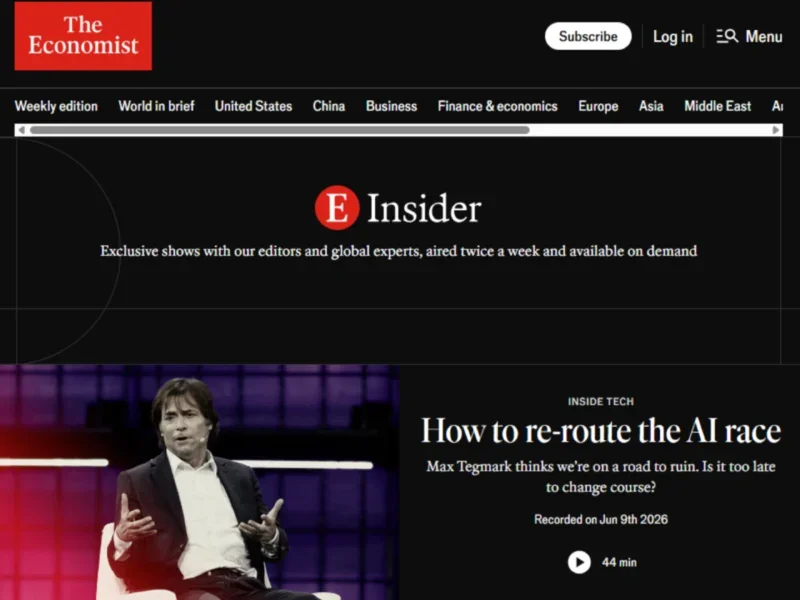
“When they’re already starting to go through that process [of unsubscribing], we’re very intentional in showcasing what they might lose if they cancel. Like, ‘hey, did you know we also had videos? Did you know that we release a new Insider interview every week?’”
Insider, a premium video strand featuring a weekly show from CEO Zanny Minton Beddoes and other weekly videos from the editorial team, was launched in October 2025. It recently made headlines after Minton Beddoes sat down with tech billionaire Elon Musk.
Around 75% of subscribers engage with Insider, according to The Economist’s full-year results.
Read more: Rise in Economist subscriber retention from Insider video strand]
Arnot said these subscribers will still cancel if they want to, but it adds an “are you sure moment?” to perhaps stay their hand.
Rather than persuading its subscribers how “amazing” The Economist is, the newsbrand’s aim is to ask the customer if they want to give up features they may not have used. This is a more “customer centric” approach, said Arnot.
How does The Economist build subscriber habit?
If a subscriber doesn’t engage with The Economist’s content for four days, the publisher will prompt them through in-app messages and “tool tips” highlighting different formats, such as videos, audio and digital editions.
“Also we send a lot of newsletters, so we make sure that there is something that is showcasing our journalism that’s always in front of them,” said Arnot. This helps encourage audiences to engage with “really sticky pieces of content” such as Insider interviews.
“We’re getting to a point where we’re trying to personalise more of the experience, and we can start pushing people towards a more tailored experience, both in the newsletters, and what’s called a ‘For You’ tab in the app.”
Should the approach differ for smaller publishers versus bigger publishers?
“For smaller publishers, they can use their size to their advantage because they can build a really unique, strong community,” said Arnot, whereas she said larger publishers should focus on specific topics or formats to achieve this.
“It’s hard to build a community around, say, 12 million people,” she said. “You might build it around certain topic areas or format areas, and maybe you can carve out niche communities in that respect.”
Arnot compared a bigger publisher to the US retail giant Walmart, which she described as a “one-stop shop for everything”, versus the “boutique” experience of a smaller publisher.
“It’s a much more curated experience. The products are unique, so that’s how I think the smaller and the larger publisher dichotomy sits. It’s not that there isn’t any value to the big publishers… but it’s much more about the breadth and access to a variety of content that is their winning formula.”
How do you compete for subscribers in an ‘attention economy’?
Competing for subscribers’ time is more challenging than competing for “share of wallet” as a publisher, Arnot said.
“I think the share of time is probably the most challenging because we’re all so time crunched, and making sure that we have formats that fit different times of the day, if you will,” she said. This means The Economist ensures it has content that can be consumed in five minutes, alongside longer-form pieces suited to weekend consumption.
“We have everything that you can mix and match to fit what you want to listen to, watch, or read,” said Arnot. She added subscribers need to be reminded that different formats exist, especially with The Economist historically known as a print publication with “lengthy articles”.
Newsletters help to push different formats, with links to content and a estimate for readers on how long it will take them to consume a particular story, as well as through marketing messages that encourage app downloads and remind users of the different types of content on offer.
How do you manage subscriber churn?
When attracting new subscribers, The Economist looks to new formats to help build out its offering, “which is why we launched Insider… to bring our journalists front and centre in a format that people are very familiar with, which is video”.
Arnot said this involved “bringing people inside our newsroom for the first time”, a step change from its long-standing decision not to include journalists’ bylines on articles in print and digital. “That was one initiative intended to broaden the reach of our audience.”
Podcasts are another acquisition tool. The Economist moved its podcast behind a paywall “because we knew a younger, more female-skewing audience was listening to our podcast, and that there was a real appetite there”.
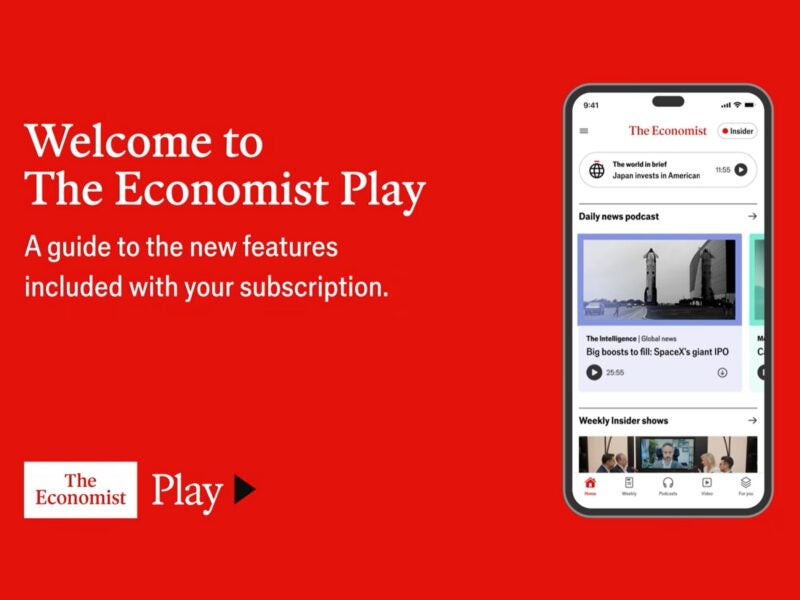
It is also trialling a lower-priced subscription tier for all of its audio and video journalism called Play. Play is around £10 a month cheaper than The Economist’s main subscription and is currently in Canada, Denmark, Norway and Sweden.
Arnot said this is “intended to appeal to a mobile-first/only audience who likes to consume their news [that way].
“That’s a really big draw for some of the younger demographics who may never go on to read digital written content.”
Has AI changed The Economist’s approach to engagement or retention?
AI is an opportunity for both acquisition and improving the subscriber experience, said Arnot.
“We have an AI lab that we stood up about a little over a year ago of eight people and their whole mandate is to evaluate and experiment with emerging technologies around AI that help enhance both acquisition and subscriber experiences.”
The lab is not designed to replace journalism, or journalists, but ensure engagement and value for subscribers, added Arnot. Already The Economist Play includes audio briefings produced using AI, with personalisation designed to help retain subscribers.
“It creates two daily audio briefings. One is personal, so based off of what you have most recently read,” said Arnot, with this running at around eight to 11 minutes. The second is editorially curated, so subscribers are exposed to stories beyond their usual interests.
“You’re not sitting in your own echo chamber just because you always read everything about economics,” said Arnot.
What is The Economist’s biggest tip for retaining subscribers?
“Always put the customer first,” said Arnot. “Imagine what you would be like as a subscriber, and what would help you retain? Because as soon as you forget that you’re actually dealing with humans on the other end, that’s when you start going off track.”
Technology should also be used with purpose rather than “because it’s novel”, she said. “Use it in a way that is actually adding value and enhancing the way that the subscriber will engage with the content.”
“Third, especially for publishers, just remember that your content is the hero,” Arnot added. “You need to make sure that people understand the value of your content, and putting it into formats that are valuable to them is really important.”
Email pged@pressgazette.co.uk to point out mistakes, provide story tips or send in a letter for publication on our "Letters Page" blog
